Way back in what I believe was 2006 I was in B&Q in Chippenham. They were feeling their way into the Trade side of business and hadn’t yet established their Trade Counter. As a result there was Trade materials on the shop floor. For me that was too much temptation to Tinker. Passing the light bulb department I spotted something different. Unbelievably they had some 70 Watt rated, “High Pressure Sodium Discharge” bulbs, similar to what was used in warehousing. They were cheap, so I bought one.
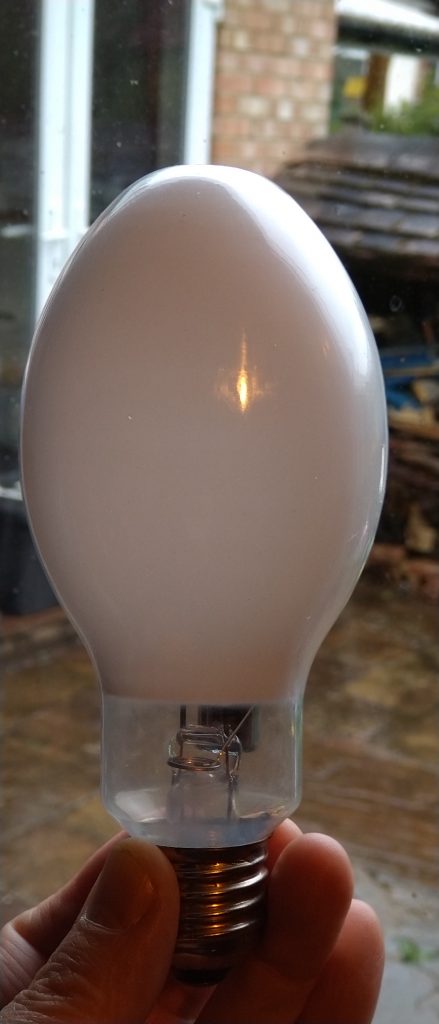
When I got home I reasoned that I could just plug it in a light fitting. Some of these bulbs require special control gear, but this one appeared to have the gear internally present. I had reasoned that B&Q were hardly likely to sell bulbs that required special fittings, out on the shop floor.
Wrong!
The bulb began to glow and then the main circuit breaker popped. And that was that.
So for the next 15 years, the bulb sat in our spare bulbs box, until a couple of weeks ago.
I found the bulb and decided that either it had to go, or I needed to prepare some control gear to get it to work. Well, its ME, so I chose the latter. I did some research.
Now this bulb turns out to be a SON-I bulb, which means it has an internal “Igniter” but it does not have a ballast. I need a ballast! Looking about on the “E of the Bay” I found a liquidated stock seller who had a complete shop light fitting for one of these bulbs, in stock, and for not too much money. So I bought one.
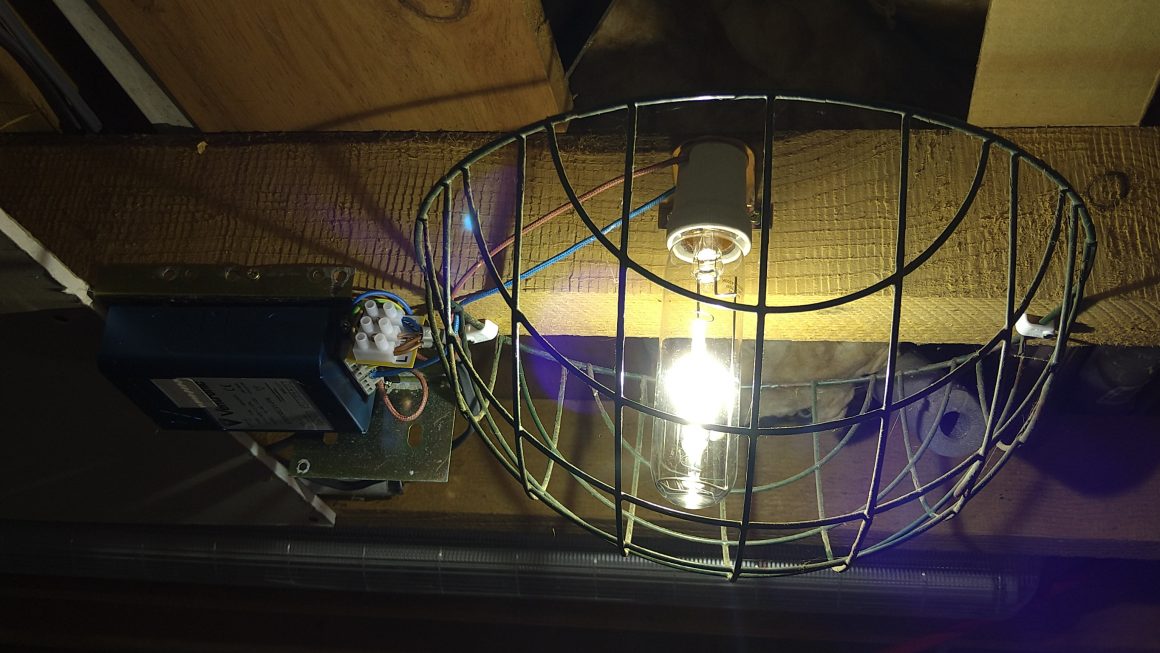
This duly arrived and I examined it. The design included an external Igniter and my research had revealed that you must not use a bulb with an internal igniter in such a fitting. So I modified the fitting to remove the Igniter circuit and just leave the ballast, with its phase correction capacitor. I fitted a cable and a plug, then added the bulb and then…
At this point, Holly decided I was likely to set the kitchen in fire, as that was where I was sat. Okay, fair point, so I moved the experiment onto the patio, and flipped the switch.
Nothing happened!
More testing, more research.
I discovered that the basic principle of a discharge lamp is very little different to a florescent lamp. After all, a florescent lamp is actually a Mercury discharge lamp with a phosphor material painted on the inside of the glass. The mercury discharge output is predominantly Ultraviolet light. This excites the phosphor and it is that which produces the visible light. Now you know why they use variations of these tubes in Tanning Studios.
So how do HID lamps work? The start up of a High Pressure Sodium bulb is the same as a florescent lamp, its a mercury discharge. So, two qualities to consider. An extinguished bulb is electrically open circuit, but a lit bulb is almost a short circuit. Put that across the mains and the bulb will almost certainly explode. Secondly, put a bulb onto the mains as it is and nothing will happen. The discharge tube has to be “struck” to get it started. To do that you need about 5000 volts. How to solve this?
The ballast is a large choke, a winding of copper wire on a iron form. In the AC world it acts like a resistor, hence limiting the current through the bulb, once its lit. Tick box 1, the bulb won’t explode anymore. But the ballast adds a second quality. If you short the bulb out with the mains applied, then the ballast will fully magnetise. Release that short and the ballast will release potential like a coiled spring, a quality known as “Back Electromotive Force”. This produces a very high voltage pulse that just happens to suit “striking” the bulb. Tick box 2.
Wait! So the Igniter shorts the bulb out? I didn’t have a ballast when I first powered this bulb up, and the igniter is internal. Oh dear! Careful viewing into the bulb shows that the bi-metallic strip that forms the pulse generator for the igniter, was quite clearly welded to its contact. There is no way to get in there to break it free, without destroying the bulb.
So, what this concludes is that I have been hanging onto a duff bulb for 15 years. Yay!
But now I have a fitting and no bulb. Back to the E of the Bay, I bought a pair of “External Igniter” bulbs, due to a massive multi-buy discount. When these arrived I went back into the fitting and restored the Igniter gear. The new bulb was fitted and the switch flipped.
Bingo!
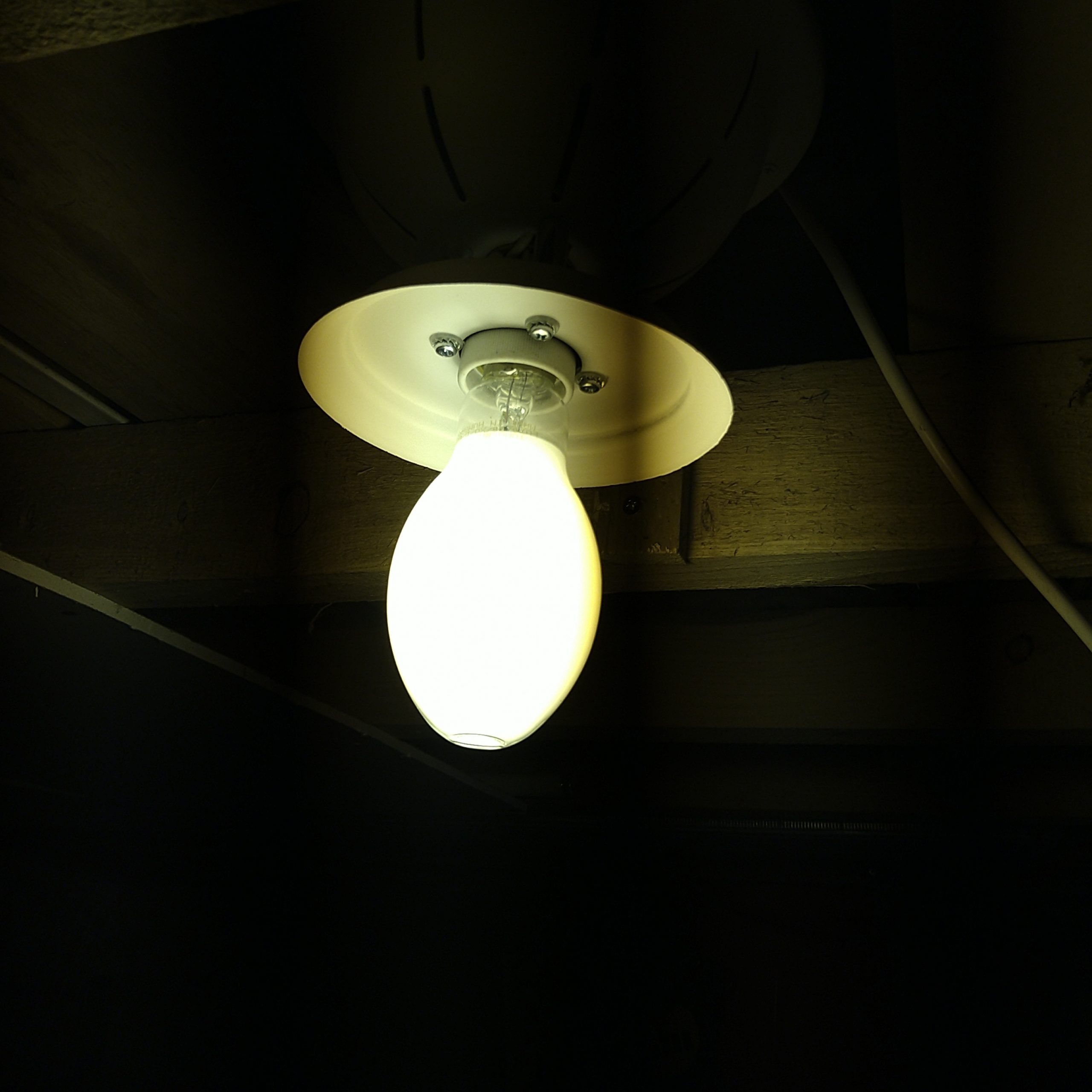
As I said, the bulb starts like a fluorescent bulb, as a mercury discharge lamp. There is no phosphor here so the light output is a very dull blue. Within seconds the Sodium starts to vaporise in the extreme heat inside the tube and this results in a colour shift to deep orange and an increase in light output. Over the next ten minutes the bulb reaches full temperature and full light output. The colour is now Golden. While the light spreads very well, it is useless if you need true colour rendering.
So I have installed it in my workshop. I haven’t removed the existing florescent fittings as if I need to go in and put the light on briefly then these are better. They are also closer to white light but with a green tinge. However the HID lamp uses half the power of the three florescent lamps. Until the advent of LED lighting the HID lamp was the most efficient light producer in terms of Lumens per Watt.
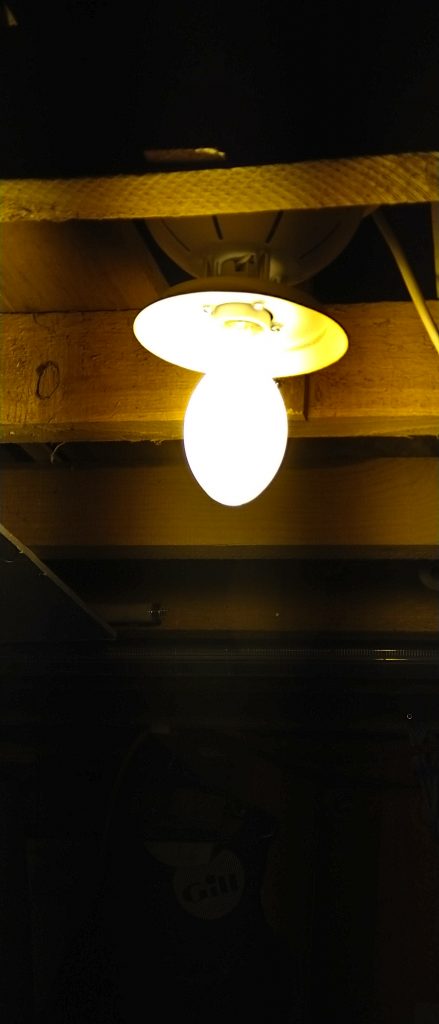
So, to conclude. I still have a 15 year old, broken bulb. And now I have a new light, which I didn’t strictly need…
But I am now knowledgeable on how these lights work.